

The sky has been running an electrical circuit for as long as this planet has existed.
Every thunderstorm you have ever watched is a visible node in that circuit — a point where charge flows between the ground and the upper atmosphere in a continuous, dynamic exchange. And sometimes, when that exchange reaches a certain intensity, something extraordinary becomes visible.
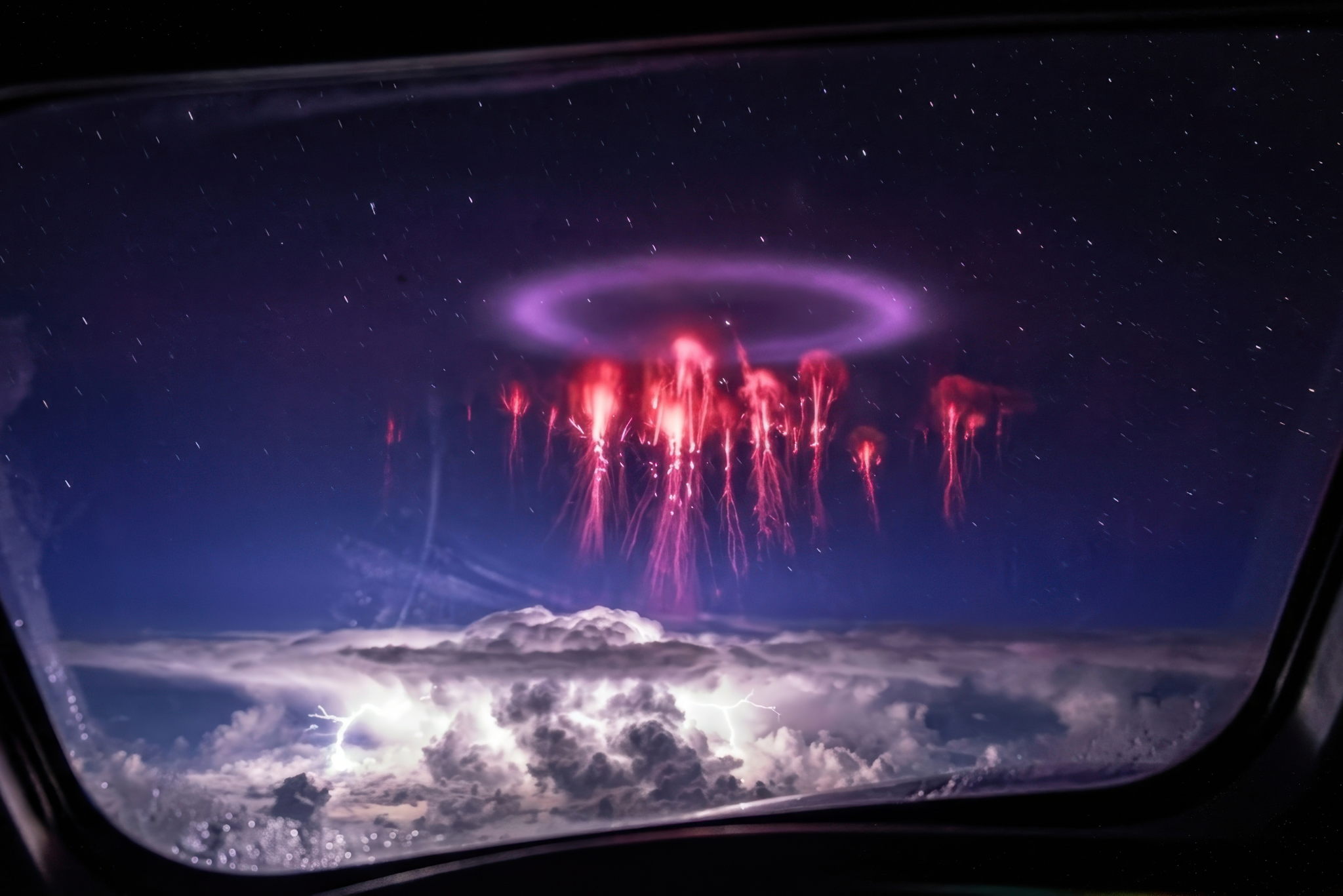
A massive crimson flash ignites high above the storm. Cold, silent, enormous. It holds its shape — jellyfish, column, tendrils of light — and vanishes in milliseconds. It is called a red sprite. And understanding what it actually is requires starting not with isolated atmospheric events, but with the electrical nature of the planet itself.
The Earth Is an Electrical System
The foundation of everything that follows is this: the Earth operates as a continuous electrical circuit connecting the ground, the atmosphere, the ionosphere, and space itself. Charge flows constantly through this system. Thunderstorms are not random weather events — they are the generators that drive the circuit, maintaining the potential difference between the Earth’s surface and the ionosphere above.
Norwegian scientist Kristian Birkeland demonstrated more than a century ago that electrical currents flow along magnetic field lines connecting Earth’s surface to the upper atmosphere, producing visible plasma phenomena — the auroras being the most widely recognized. These Birkeland currents are field-aligned plasma currents, and they operate at every scale the circuit demands.
Plasma physicist Anthony Peratt of Los Alamos demonstrated through laboratory experiments and computer simulations that filamentary plasma structures — identical in behavior to Birkeland currents — appear consistently across 14 orders of magnitude, from microampere laboratory discharges to cosmic-scale plasma events. The physics is the same. The scale changes. The behavior does not.
Red sprites are that physics made visible in the atmosphere above a thunderstorm.
What a Red Sprite Actually Is
A red sprite is a large-scale cold plasma discharge — a visible node in the Earth’s electrical circuit where current flowing between the ionosphere and the lower atmosphere briefly illuminates the mesosphere in deep crimson.
The word “cold” distinguishes sprites fundamentally from the hot plasma channel of conventional lightning. Sprites carry none of the extreme heat of a ground bolt. Their physics is closer to a fluorescent tube discharge — a diffuse, non-thermal plasma event — than to anything in the storm below.
They appear moments after a powerful positive lightning discharge. A sudden crimson flash, often shaped like a hanging jellyfish, a column of light, or clusters of spiny tendrils reaching in both directions. Some reach 50 kilometers in diameter. Their altitude range runs from 50 to 90 kilometers. Their duration: milliseconds. Then the circuit rebalances, and the sky goes dark again.
Eyewitnesses reported these discharges as far back as the 1700s. The circuit was always running. The instruments to document it came later.
The Plasma Mechanics: How the Discharge Forms
When a powerful positive lightning strike moves charge between the cloud and the ground, it creates an abrupt electrical imbalance in the circuit above. The charge that produces the sprite does not come from below the cloud — it comes from the mesosphere itself, fed by the ionosphere above. As plasma researcher Walt Thornhill noted directly: “The charge that produces sprites is not below in the cloud, it’s in the mesosphere itself.”
That charge imbalance generates an intense electric field that propagates through the thinning air of the mesosphere. At those altitudes, air density is low enough that the electrical breakdown threshold drops dramatically. Free electrons accelerate. They collide with nitrogen and oxygen molecules in a cascading chain reaction — an electron avalanche — and the gas begins to glow.
The discharge propagates through successive ionization waves called streamers. Occasionally, double layers in the plasma explode, concentrating energy into high-energy particle bursts. The entire visible event — from trigger to extinction — takes around 20 milliseconds.
Laboratory researchers have fully replicated this process using low-pressure air between 0.2 and 3 Torr with high-voltage pulses, producing miniature plasma columns that match the behavior, structure, and color of real sprites in every measurable way. The physics is reproducible on a bench.
Why They Glow Red — and Why the Color Shifts
The crimson color is a direct consequence of nitrogen plasma behavior under low atmospheric pressure.
At ground level, excited nitrogen molecules are quenched by surrounding oxygen before they can emit visible light. At 80 kilometers altitude, oxygen density is so low that nitrogen dominates the emission spectrum completely. The result is a deep red glow — the first positive system emission of nitrogen molecules, consistent across every laboratory analog ever produced.
As the discharge propagates and air pressure increases toward the cloud tops below, the red emissions give way to blue and blue-green. The reduced electric field strength at lower altitudes shifts the spectrum. The color gradient visible in photographs of sprites — deep red above, blue tendrils below — is a direct readout of the electric field strength and air pressure across the discharge column. The circuit writes its own signature in color.
The Full Family of Atmospheric Plasma Events
Red sprites are the most visible member of a broader family of atmospheric plasma discharges. Each type corresponds to a different position in the circuit, a different altitude, and a different plasma mechanism.
Blue jets eject upward directly from the top of a thundercloud, reaching 40 to 50 kilometers, driven by a different charge distribution and glowing blue due to nitrogen second positive system emissions — the same spectral shift seen in the lower tendrils of sprites.
Elves are rapidly expanding rings of ionized air forming at roughly 90 kilometers altitude. They result from the electromagnetic pulse radiated by the lightning discharge — a shockwave of ionization spreading outward at the speed of light, lasting under a millisecond.
Green ghosts appear briefly after sprites fade. Active independent research continues to characterize the molecular transitions responsible for their emission — they remain among the least understood plasma events in the atmospheric circuit.
Together, these phenomena are the visible expressions of a circuit that runs continuously — from the ground, through the storm, through the mesosphere, through the ionosphere, and into space. The thunderstorm is not the source. It is the switch.
Sprites as Part of a Larger Circuit
This is where understanding sprites requires stepping back from the single event and looking at the system.
Thornhill and the Electric Universe framework describe the Earth as enveloped in a cosmic discharge focused on the Sun. Sprites, in this view, are not isolated mesospheric curiosities. They are the visible moments when the current density in the atmospheric circuit exceeds the local breakdown threshold — brief illuminations of a system that is always active, whether visible or not.
Leakage currents drive the vertical dynamics of thunderstorms. The charge builds in the cloud not as a random consequence of water droplet friction, but as part of the circuit’s continuous flow. The lightning strike that triggers a sprite is the lower portion of a discharge whose upper portion reaches into the ionosphere and beyond. The electromagnetic pinch effect ensures that the energy of a sprite focuses onto any large electrical conductor in its domain — a fact with documented consequences for high-altitude operations.
The circuit runs top to bottom. The sprite is a window into it.
How to Photograph a Red Sprite
The approach that works: a clear, unobstructed view of a powerful, distant thunderstorm — ideally 200 to 500 kilometers away — with the storm anvil visible above the horizon. A wide-angle camera on a tripod, shooting continuous long-exposure video throughout the night, gives the highest probability of capture.
A mirrorless or DSLR camera with a fast wide-angle lens, manual exposure control, and a high frame rate is the right tool. Smartphone cameras lack the sensor sensitivity and frame rate to reliably capture millisecond-duration plasma events.
The most productive locations globally: the Great Plains of the United States during summer convective season, the Sahel region of Africa, and the plains of South America — wherever deep, powerful thunderstorm systems generate the strongest positive lightning discharges and the flattest terrain gives the clearest sight lines.
Independent photographers have documented sprites consistently from ground level. The circuit is visible to anyone willing to point a camera above the storm and wait.
Frequently Asked Questions About Red Sprites
Are sprites only visible above storms, or can they extend further?
In the Electric Universe framework, sprites are visible nodes in a circuit that connects the ground to the ionosphere continuously. The discharge illuminates the mesosphere, but the current path extends across the full circuit — from the surface through the storm, through the mesosphere, through the ionosphere, and into space. The visible portion is determined by where the local breakdown threshold is exceeded, not by where the circuit begins or ends.
How long does a red sprite last?
Between 1 and 20 milliseconds. High-speed cameras shooting thousands of frames per second are the standard tool for capturing and studying their internal streamer structure in detail.
Have red sprites always existed?
Eyewitnesses documented them as far back as 1886, and likely centuries before that. The plasma circuit that produces them has been operating for as long as the Earth has had an atmosphere and thunderstorms. The instruments to confirm and study them came later — but the phenomenon itself is ancient.
What exactly triggers a sprite and not ordinary lightning?
The key trigger is a positive cloud-to-ground lightning strike — a discharge where positive charge moves from the cloud to the ground. Positive lightning carries significantly more charge and generates a stronger electromagnetic pulse upward into the mesosphere. It drives 99% of observed sprite events. The stroke below closes the lower part of the circuit; the sprite above closes the upper part.
The Circuit Has Always Been Running
Every thunderstorm that has ever moved across this planet has been part of a continuous electrical exchange between the ground and the sky. Sprites are the moments when that exchange becomes bright enough to see.
The plasma physics is clean, consistent, and laboratory-confirmed. The streamer mechanics are documented. The nitrogen emission spectrum is understood. The Birkeland current framework explains the filamentary structure. The circuit model explains why the charge comes from above, not below.
The only thing that changes when you understand sprites correctly is the scale of what you are looking at. A single crimson flash lasting 20 milliseconds is a window into a planetary electrical system that has been operating — quietly, continuously, invisibly — since long before anyone looked up to name it.
The circuit is always running. The sprite just makes it visible.